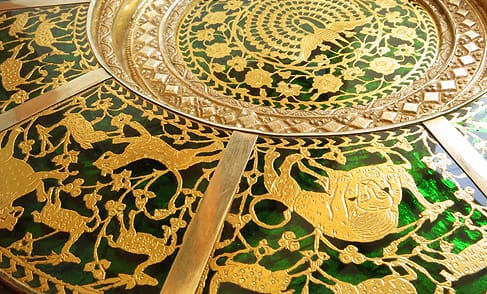
Imagine a piece of jewelry where 23-karat gold doesn’t just sit on a gemstone but fuses into the very soul of the glass itself. This is Thewa Kala, a mesmerizing art form that hails from the small town of Pratapgarh in Rajasthan. Unlike traditional enamel work (Meenakari), Thewa creates a breathtaking contrast between glittering gold and deep, translucent glass without using a single drop of glue.
For centuries, this craft remained a closely guarded secret within a single family. Today, we peel back the layers of this “Golden Glass” magic.

A Legacy Etched in Gold (History)
The story begins in 1767, when a goldsmith named Nathu Lal Sonewal invented a revolutionary technique in Pratapgarh. The local ruler, Maharawat Sawant Singh, found the work so exquisite that he bestowed the title of “Raj Soni” (Royal Goldsmith) upon the family.
Since then, the Raj Soni family has passed this secret down from father to son for over nine generations. They fiercely protect their techniques; traditionally, they do not even teach their daughters or daughters-in-law the craft to prevent the secret from leaving the household.
The Making of Thewa: A Symphony of Fire and Skill
Creating a single piece of Thewa jewelry is a labor-intensive process that can take a skilled artisan over a month. Here is how they transform raw metal and glass into a masterpiece:
1. Preparing the Canvas (Therna)
The artisan begins by taking a piece of pure 23-karat gold and beating it into a paper-thin foil, known as the Thewa ki Patti. They must achieve a specific thickness—too thick, and it won’t fuse; too thin, and it melts.
2. The Delicate Etching (Kandarana)
Next, the artisan spreads a layer of natural lac (resin) on a wooden board and warms it. They press the gold foil onto this sticky surface. Using fine chisels and styluses, the artist sketches intricate narratives—often depicting hunting scenes (Shikargah), Lord Krishna, or peacocks.

3. Creating the ‘Jali’ (Openwork)
This is the most crucial step. The artisan carefully cuts away the “negative space” of the design, leaving behind a delicate gold net or Jali. They peel this fragile gold skeleton off the lac board and clean it meticulously.
4. The Secret Fusion
This step distinguishes Thewa from all other jewelry forms. The artisan places the gold mesh onto a piece of colored Belgian glass (often red, green, or blue). They heat the entire assembly in a furnace. Through a precise, secret temperature control, the gold fuses directly onto the glass surface. The glass cools, and the gold becomes one with it—creating a mirror-like effect on the reverse side.
5. The Final Setting
Finally, a silversmith mounts the fused glass-and-gold unit into a silver or gold bezel (the Vaada) to create rings, pendants, or ornate boxes.

Why Thewa is Unique
- Geographical Indication (GI) Tag: The Government of India awarded Thewa Art the GI tag (No. 244), certifying that authentic Thewa comes exclusively from Pratapgarh.
- No Adhesive: The bond between the gold and glass is purely physical and thermal.
- Light & Reflection: The glass background catches light, making the gold artwork “pop” in a way that solid metal jewelry cannot mimic.
Conclusion
Thewa Kala is more than just jewelry; it is a frozen moment of history. When you hold a piece of Thewa, you hold the legacy of the Raj Soni family and the royal courts of Rajasthan. Whether you are a collector of heritage art or a fashion enthusiast looking for a statement piece, Thewa offers a narrative of elegance that modern machinery simply cannot replicate.